Many students get nervous when they see maps in the IELTS Listening test. But trust me – once you know how the speaker gives directions, this question type becomes super fun and easy!
Let’s learn step by step 👇
🗺️ 1️⃣ What is a Map Labelling Question?
You’ll see a map or plan — maybe of a park, museum, or college campus.
Your task is to label places (like “Car park”, “Playground”, “Pavilion”) using the correct letters (A, B, C…).
👉 The speaker will describe the map and give you directions like:
“Go straight ahead and you’ll see the playground on your left.”
Your job is to follow the route carefully and write the correct letter.
🧭 2️⃣ First Step: Get Your Orientation Right!
Before the audio starts, use your 30 seconds wisely.
✅ Check these three things:
- The title (it tells you what the map is about).
- The compass (North, South, East, West).
- The starting point (often marked with an arrow or “Entrance”).
🎯 Pro tip: Always find where the speaker starts — that’s your first clue to everything!
👂 3️⃣ Listen for Direction Words
Direction words are your “listening GPS.”
They guide you step by step through the map.
Most common direction words:
🔹 Go straight ahead
🔹 Turn left / Turn right
🔹 Next to / Beside / Opposite
🔹 Behind / In front of
🔹 Across from / At the corner / At the end
🧠 4️⃣ Predict Before You Listen
Before the audio starts, quickly guess what makes sense in each blank area.
Example:
- “Car park” → near the entrance
- “Playground” → open space
- “Notice board” → beside the gate
🗣️ 5️⃣ Listen for Landmarks
The speaker will guide you using landmarks:
“You’ll see the cricket pitch on your right, just before the pavilion.”
✍️ 6️⃣ Write Answers Immediately
Don’t wait until the end — write while listening!
Even short notes are fine (like “A”, “north side”, “by gate”).
Visualization means imagine the map in your mind.
When you hear directions like “turn left” or “next to the pond,”
try to see that route mentally.
🌟 FAHIM Sir’s Extra Tips
✨ Most IELTS maps follow a clear direction — clockwise, anticlockwise, or straight path.
✨ Don’t panic if you miss one answer; refocus quickly and catch the next one.
✨ Practice with Cambridge past tests regularly.
✅ Summary Table
| Step | What to Do | Bengali Meaning |
|---|---|---|
| 1 | Read the title & map | টাইটেল ও ম্যাপ ভালোভাবে দেখো |
| 2 | Find the start point | কোথা থেকে শুরু করছে ধরো |
| 3 | Listen for directions | বাঁ, ডান, পাশে এসব শব্দ ধরো |
| 4 | Predict locations | আগে থেকে আন্দাজ করো |
| 5 | Follow landmarks | চেনা জায়গা দিয়ে বোঝো |
| 6 | Write quickly | শুনে শুনে লিখে ফেলো |
| 7 | Practice daily | প্রতিদিন অভ্যাস করো |
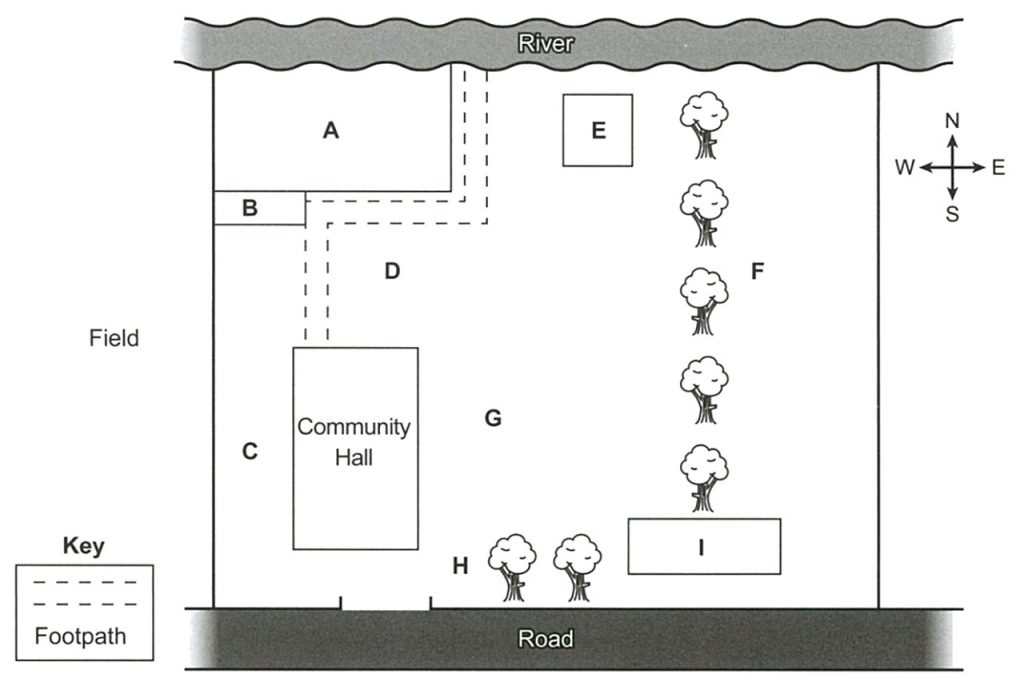
15 New car park ……………
16 New cricket pitch ……………
17 Children’s playground ……………
18 Skateboard ramp ……………
19 Pavilion ……………
20 Notice board ……………
🏁 Final Words
Map Labelling looks tough at first, but it’s really about smart listening and clear imagination.
Once you learn the pattern, you’ll love this section! 💪
So next time you see a map in IELTS Listening –
🎯 Don’t panic, just follow it like FAHIM Sir is guiding you step by step in class!
For IELTS Listening Part -2 MCQ Click Here
For IELTS Listening Part -3 MCQ Click Here
IELTS Listening: Matching Questions in Part 2 & 3
IELTS Listening: Flow-chart Completion