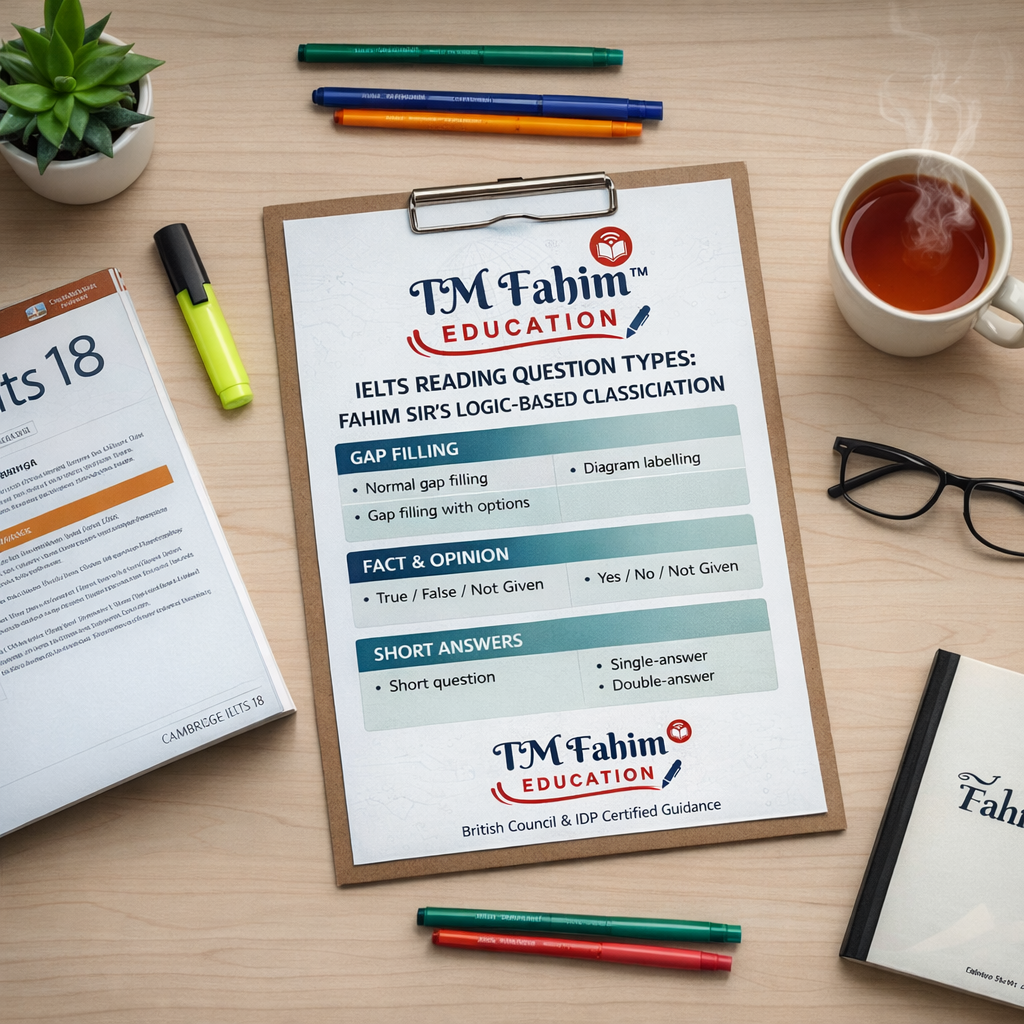
🌐 Understanding the IELTS Reading Test
The IELTS Reading Test measures how well you can understand information, opinions, and arguments in written English. You’ll answer 40 questions in 60 minutes, and every question type demands a different strategy.
Whether you are preparing for Academic or General Training, knowing the question patterns and practicing with the right methods can make all the difference between Band 6.5 and Band 8.0.
Let’s explore all the major question types with practical examples
🔹 1. Gap-Filling (Completion) Questions
These questions test your ability to identify specific information and use synonyms.
🧩 a) Sentence / Summary Completion
You’ll complete sentences or summaries using words from the passage.
Example:
The main reason for the decline in bird population is _______.
If the text says:
“Bird numbers have fallen mainly due to loss of natural habitats.”
✅ Answer: loss of natural habitats
💡 Tip:
- Always check the word limit — e.g., “NO MORE THAN TWO WORDS.”
- Focus on nouns and key ideas, not function words.
🧩 b) Gap-Filling with Options
Here, options are given.
Example:
The project was delayed because of:
A) lack of workers
B) shortage of funds
C) poor management
If the passage says:
“The project could not continue as the budget was insufficient.”
✅ Answer: B) shortage of funds
🎯 Tip:
- Identify synonyms — “insufficient budget” = shortage of funds.
- Eliminate grammatically or logically impossible options.
🧩 c) Diagram / Label Completion
These often appear in scientific or process-based passages.
Example:
A diagram shows a wind turbine — arrows point to parts labelled (A), (B), (C).
You must fill in:
A – _______
B – _______
C – _______
If the passage says:
“The blades rotate the shaft, which powers the generator to produce electricity.”
✅ Answers:
A – Blades
B – Shaft
C – Generator
🧠 Tip:
- Focus on technical nouns and sequence words (first, then, finally).
🔹 2. Multiple Choice Questions (MCQ / Double MCQ)
These test your ability to recognize main ideas, specific details, and opinions.
🎓 a) Single MCQ
Example:
According to the passage, what caused the rise in pollution?
A) Industrial waste
B) Car emissions
C) Population growth
If the text says:
“The increasing number of vehicles on the road has significantly worsened air quality.”
✅ Answer: B) Car emissions
🎓 b) Double MCQ
Example:
Which TWO advantages of online learning are mentioned?
A) Low cost
B) Easy access
C) Face-to-face feedback
D) Group discussions
If the passage mentions only A and B,
✅ Answer: A & B
💡 Tip:
Underline keywords and check which points are explicitly mentioned, not assumed.
🔹 3. True / False / Not Given : Yes / No / Not Given (Y/N/NG)
These are among the most challenging question types.
- T/F/NG → used for factual statements.
- Y/N/NG → used for opinions or beliefs.
📘 Example (T/F/NG):
The Nile River is the longest river in Asia.
If the passage says:
“The Nile, the world’s longest river, flows through Africa.”
✅ Answer: False (because it’s in Africa, not Asia).
📗 Example (Y/N/NG):
The writer believes that artificial intelligence will replace teachers.
If the passage says:
“AI can assist teachers but can never replace human guidance.”
✅ Answer: No
⚖️ Tip:
- Not Given means there’s no clear information — don’t assume!
- Always locate keywords and read around them for context.
🔹 4. Matching Questions
Matching questions appear in several formats, each requiring a slightly different approach.
🧭 a) List of Headings
You’ll match headings to paragraphs.
Example:
Headings:
i. Causes of climate change
ii. Solutions to global warming
iii. Impact of rising sea levels
If Paragraph B discusses “how governments can reduce carbon emissions” →
✅ Answer: ii. Solutions to global warming
💡 Tip: Focus on the main idea of the paragraph, not small details.
📖 b) Paragraph Matching (Information Matching)
You’ll match statements to paragraphs that contain the relevant information.
Example:
Statement: “The experiment failed due to poor planning.”
If this idea appears in Paragraph D, then ✅ Answer: D
👥 c) Name Matching
You’ll match names to opinions or statements.
Example:
A) Dr. Smith
B) Dr. Jones
C) Dr. Khan
Question: Who believes the results were unreliable?
If the passage says:
“Dr. Jones criticised the study, saying the results could not be trusted.”
✅ Answer: B – Dr. Jones
💡 Tip:
- Scan for names in CAPITAL letters.
- Read the verbs of opinion (e.g., believed, argued, suggested).
🧩 d) Sentence Endings Matching
You match sentence beginnings with logical endings.
Example:
- The factory closed because…
a) workers were unhappy
b) it ran out of money
c) the manager resigned
If the passage says:
“The company’s bankruptcy led to the closure of the factory.”
✅ Answer: 1 – b)
🔹 5. Short Answer Questions
These require writing direct answers (1–3 words) from the passage.
Example:
What kind of animal is the platypus?
If the passage says:
“The platypus is a semi-aquatic mammal native to Australia.”
✅ Answer: semi-aquatic mammal
🕒 Tip:
- The answers appear in order in the passage.
- Copy spelling exactly as in the text.
🔹 6. Miscellaneous Question Types
Sometimes you’ll find combinations such as:
- Table or Flow Chart Completion
- Classification (A/B/C type)
- Matching Features or Events
- Sentence Completion
Example:
Match each country with its contribution to space research.
If the passage says:
“The USA developed the Apollo program, while Russia launched Sputnik.”
✅ Answer:
- USA → Apollo program
- Russia → Sputnik
🧠 Tip: Identify keywords like names, years, and unique facts.
🚀 Fahim Sir’s Expert Tips for IELTS Reading
- Divide your time: 20 minutes per passage.
- Underline keywords in questions before reading.
- Don’t overthink “Not Given” — if it’s not clearly there, it’s Not Given.
- Read actively — focus on understanding, not memorizing.
- Practice with Cambridge IELTS Books 9–18 regularly.
💬 Final Thoughts
IELTS Reading success is about strategy, not just speed.
Once you understand how each question type works, you’ll notice patterns — and that’s where your confidence and accuracy truly grow.
If you’d like to master every Reading question type with real Cambridge examples and guided practice, join my IELTS Reading Masterclass at TM FAHIM Education, Kulaura or study online via www.fahimsir.com.
📞 Contact: +8801714627596
📧 Email: tmfahimeducation@gmail.com
🏫 TM FAHIM Education, Dakshin Bazar, Kulaura, Moulvibazar, Bangladesh
🌐 www.fahimsir.com
For authentic practice materials, I recommend the Cambridge IELTS Series (Books 9–18), available on Cambridge English’s official site