
Why this guide?
IELTS Speaking is a short face-to-face test that many learners fear — but it’s one of the most predictable and improvable parts of IELTS. This guide gives a deep, student-friendly explanation of the test format, exactly what examiners look for, and a plethora of real examples you can practise right away. It’s ready to publish on fahimsir.com and optimised for Yoast SEO and readability.
Quick facts
- Duration: 11–14 minutes
- Format: 3 parts (Part 1: personal; Part 2: cue card; Part 3: discussion)
- What’s tested: Fluency & coherence, Lexical resource (vocabulary), Grammatical range & accuracy, Pronunciation
- Tone of the test: Conversation — not an interrogation
What the examiner is actually marking
Understanding the four scoring criteria is the fastest way to improve. Below each criterion you’ll find clear examples and short practice tips.
1) Fluency & Coherence
Meaning: Speak at a natural pace without long pauses; connect ideas logically.
Weak answer: “I like movies. They are good.”
Strong answer: “I love watching movies, especially on weekends — they help me relax after a busy week and I enjoy discussing story ideas with friends.”
Practice tip: Give a short reason + an example for every answer (1–2 extra sentences).
2) Lexical Resource (Vocabulary)
Meaning: Use topic-appropriate words and some variety — accuracy matters more than complexity.
Basic: “I like food.”
Improved: “I enjoy trying different cuisines; recently I’ve been exploring Bengali street food because of its bold flavours.”
Practice tip: Learn 8–10 words/phrases for each common topic (hometown, study, work, food, hobbies).
3) Grammatical Range & Accuracy
Meaning: Show a mix of simple and complex sentences accurately.
Incorrect: “Yesterday I go market.”
Correct: “Yesterday I went to the market to buy fresh fruit.”
Practice tip: Practice rephrasing one simple sentence into a complex one every day.
4) Pronunciation
Meaning: Clear pronunciation, correct word stress and natural intonation; accent is not graded.
Tip: Pause at commas, stress the important word in a sentence, and use rising intonation for questions.
Part 1 — Introduction & personal questions (4–5 minutes)
These are short, familiar questions meant to relax you. Keep answers 2–4 sentences.
Sample Q & A:
Q: “Where do you live?”
A: “I live in Kulaura, Moulvibazar. It’s a quiet town known for its natural beauty and friendly people.”
Q: “Do you work or study?”
A: “I’m studying Business Administration. I enjoy marketing classes because they let me be creative.”
Practice drill: Prepare 20 answers (common topics) and practise answering each in 30–40 seconds.
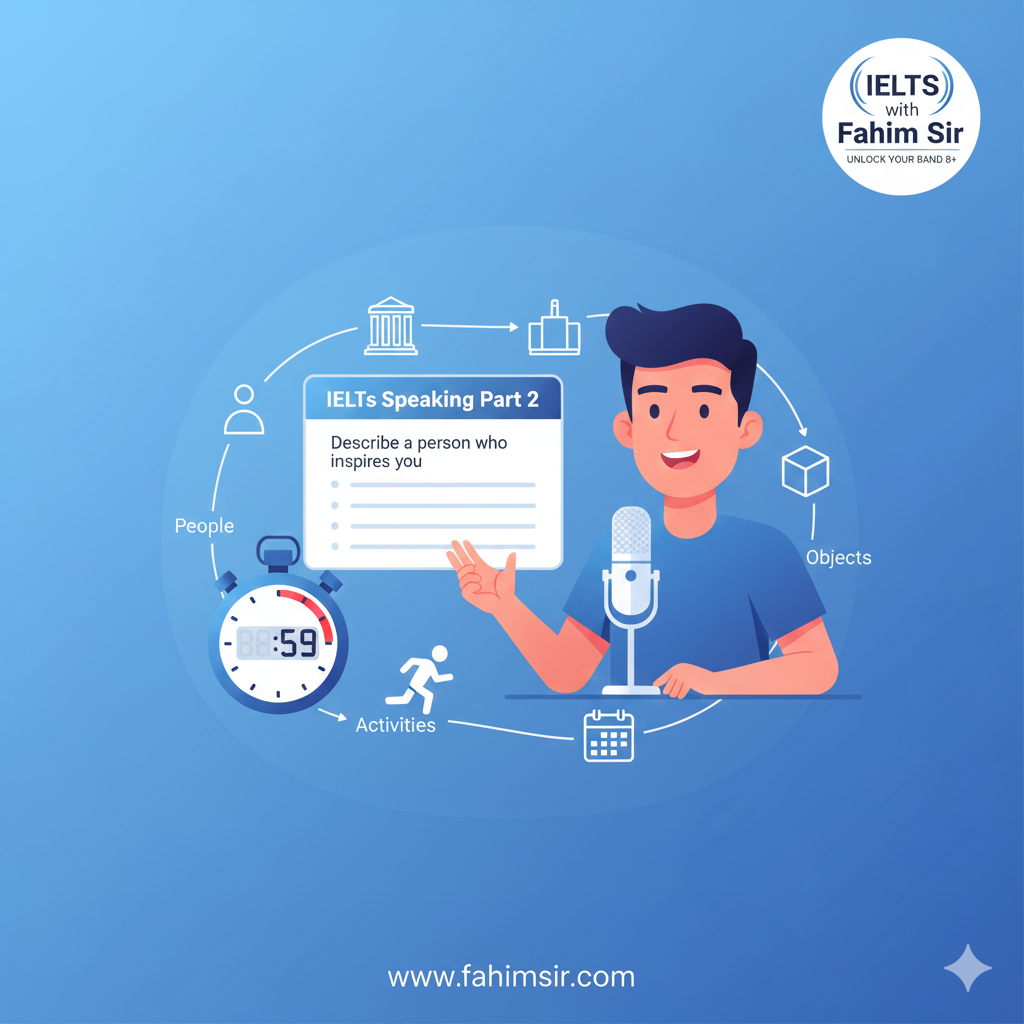
Part 2 — Long turn / Cue card (3–4 minutes)
You get a card (topic + bullet points), 1 minute to prepare, and 1–2 minutes to speak continuously.
Example cue card:
Describe a memorable trip. You should say: where you went, who you went with, what you did, and explain why it was memorable.
Model answer (1–2 minutes):
“One of my most memorable trips was to Cox’s Bazar last summer with my cousins. We spent three days on the beach, tried local seafood and walked along the shoreline every evening. The sunset was spectacular — orange and pink skies — and it felt special because we all had time to relax together after a busy year. That trip helped me reconnect with family and take a break from my studies.”
Structure to use: (1) Intro — when/where, (2) Main events — two or three details, (3) Reason why memorable, (4) Short concluding sentence.
Preparation tip: Use the 1 minute to joton 3-4 bullet points: opening line, 2–3 details, finishing feeling.
Part 3 — Discussion (4–5 minutes)
Longer, more abstract questions linked to Part 2. This is where you can show opinion, reasoning and examples.
Example sequence: (from “memorable trip” cue card)
Q: “Why do people travel nowadays?”
A: “People travel for many reasons — leisure, work, education and cultural curiosity. With cheaper flights and social media, more people want to see new places and share experiences online.”
Q: “Does tourism have any negative effects?”
A: “Yes. While tourism boosts local economies, uncontrolled tourism can harm the environment and local traditions. Sustainable tourism policies are essential to protect communities.”
How to answer: Start with a clear opinion, give two reasons, and add a short real example.
Common mistakes and how to fix them
- Too short answers: Add at least one reason and one brief example.
- Memorised answers: Don’t use fixed scripts — adapt templates to your life.
- Speaking too fast: Slow down, use short pauses, focus on clarity.
- Overuse of complex words: Use words you control accurately.
- Silent pauses while thinking: Paraphrase or give a simple starter sentence to buy thinking time.
Practice plan (4 weeks)
- Week 1 (Foundation): 10 min/day — Part 1 topics; record and listen.
- Week 2 (Expansion): 15 min/day — Cue card practice; use 1 min prep + 2 min talk.
- Week 3 (Polish): 20 min/day — Part 3 discussions; practise opinion + reasoning.
- Week 4 (Mock & review): Full mock tests twice a week; evaluate with checklist.
FAQs
Q: How long is the IELTS Speaking test?
A: 11–14 minutes.
Q: Do I need a British accent?
A: No — accent is not graded. Clear pronunciation and natural rhythm matter.
Q: Can I prepare for Part 2 in advance?
A: You can practise topics, but avoid memorised scripts. Use templates to structure answers.
Q: How can I stop hesitating?
A: Use short starter phrases (“Well, I think…”, “Actually, I often…”) and practise speaking aloud daily.
Contact / Author:
Tanvir Mahtab Fahim – British Council & IDP Certified Teacher
TM Fahim Education – Official IELTS Registration Center
📧 tmfahimeducation@gmail.com
📞 +8801714627596
IELTS Speaking Part 1: Tips, Techniques, and Strategies by FAHIM SIR
IELTS Speaking Test Part 3 : FAHIM SIR



1 thought on “What Is IELTS Speaking? (Student-Friendly Guide)”
Pingback: IELTS Speaking Part 2 – Complete Guide - Fahim Sir